
- About us
- Products
- Services
- Documentation
- Contacts
 English


Fabric Expansion Joints
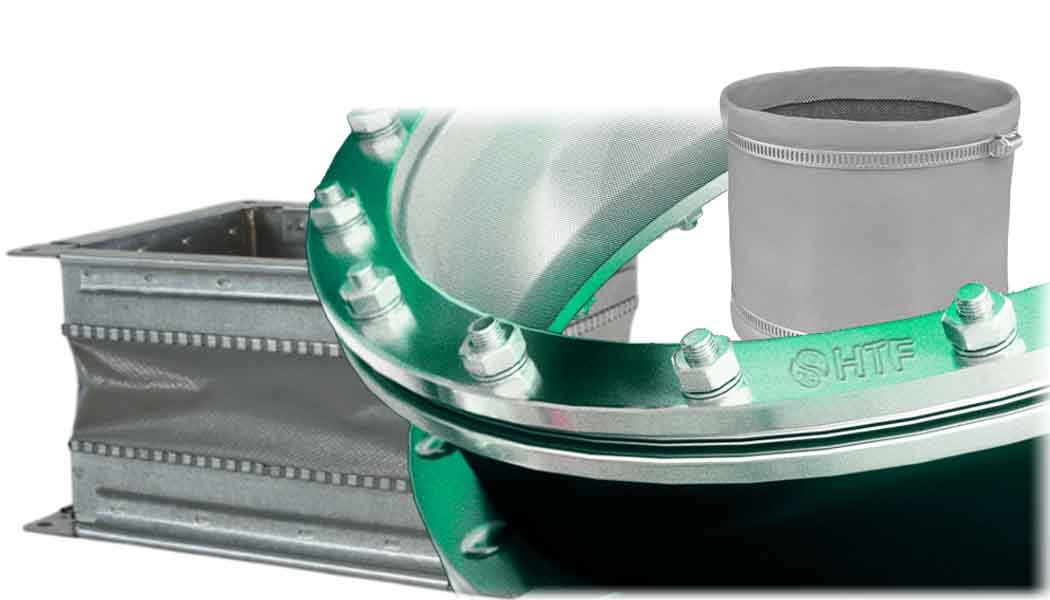
Fabric Expansion Joints for Industrial Ducts and Pipelines
Fabric (soft) expansion joints are flexible elements installed on pipelines and gas ducts to compensate for thermal, vibrational, and mechanical movements. They ensure tightness, reduce equipment load, and extend the service life of gas-transport systems.
Internal Structure of a Fabric Expansion Joint
- Inner layer — heat-resistant lining (fiberglass, silica fabric, PTFE, ceramic textiles) in contact with the gas stream. Provides resistance to abrasion, acids, SO₂/SO₃, and NOx.
- Insulation layer — thermal insulation materials (basalt fiber, silica) that reduce the temperature of the outer layers.
- Compensation layer — reinforced fabrics responsible for elasticity, tensile work, and bending capability.
- Outer protective layer — dense fabrics or PTFE membranes resistant to weathering, mechanical damage, and vibration.
- Sealing — heat-resistant cords or gaskets ensuring complete tightness.
Temperature Application
- Up to 150–250°C — standard fiberglass with polymer coatings (silicone, PVC, polyurethane), suitable for air ducts and ventilation.
- Up to 450–550°C — fiberglass with silica layers and basalt insulation; optimal for flue gases of boilers and power plants.
- Up to 700–900°C — high-strength silica fabrics and mineral insulators for metallurgy, dryers, and abrasive gas ducts.
- Up to 1100–1200°C — ceramic fabrics based on Al₂O₃/SiO₂ reinforced with high-temperature fibers; used in severe conditions:
- aggressive flue gases with high SO₂ and SO₃ concentrations;
- exhaust after furnaces and thermal units;
- rotary kilns, dryers, metallurgical gas ducts;
- high thermal shocks and load fluctuations.
Forms of Fabric Expansion Joints
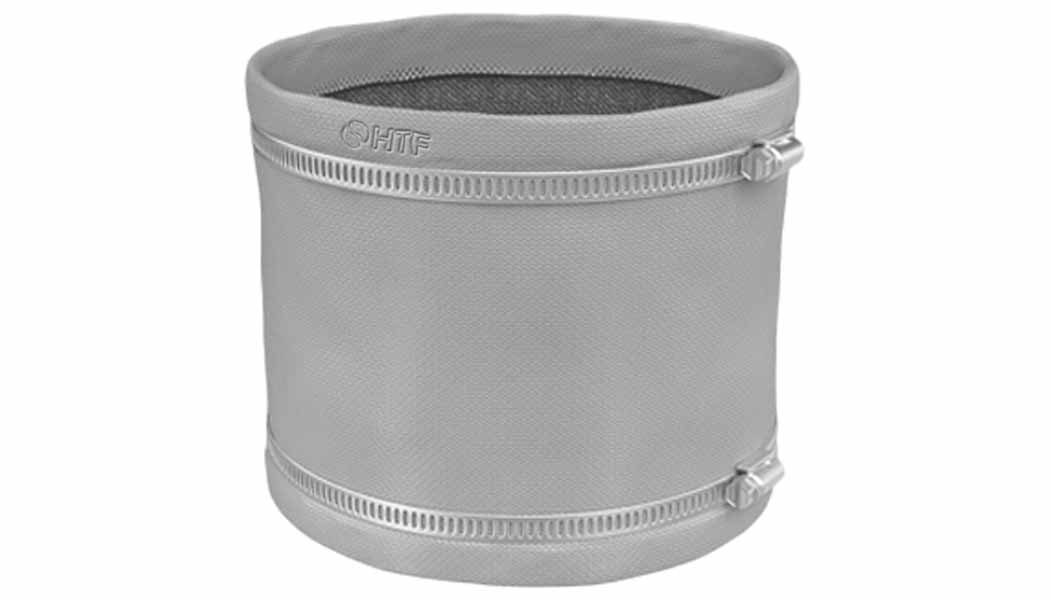
The form of the joint is selected according to duct design, load type, and installation limitations:- Round expansion joints
- Installed on pipelines and round nozzles.
- The most common solution for fans, ID/FD blowers, cyclones, and filters.
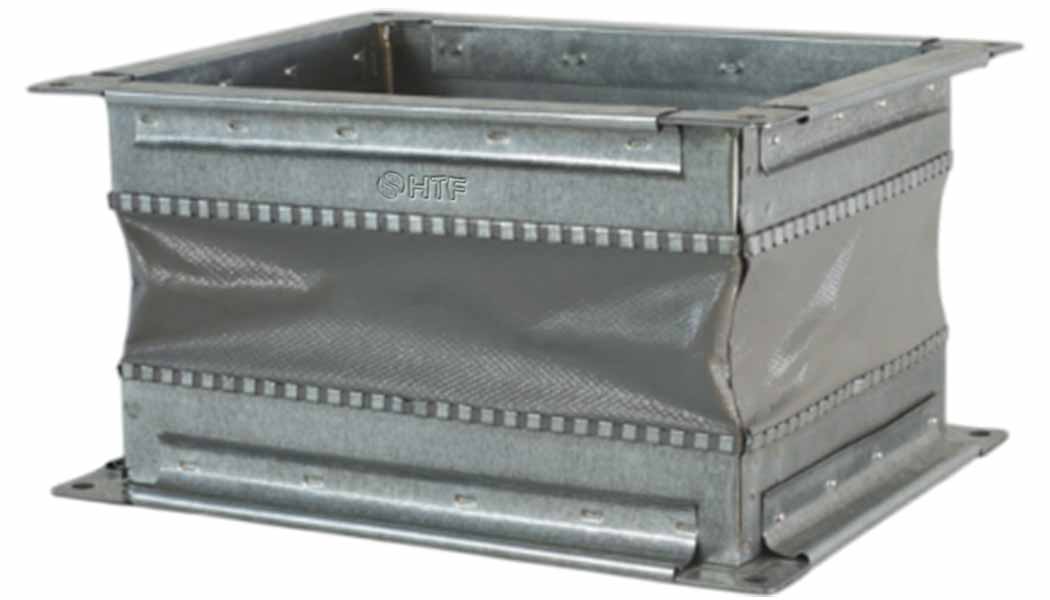
- Rectangular
- Used on rectangular ducts of boilers, power plants, and dust-extraction systems.
- Can be manufactured in large dimensions without losing elasticity.
- Transition-type expansion joints
- Transition from round to rectangular section or vice versa.
- Installed at fan inlets/outlets, gas-cleaning equipment, heat exchangers.
- Allow compensation in complex installation conditions.
- Shape-changing expansion joints
- Corrugated or folded designs for increased compensation capability.
- Complex geometries for non-standard units.
- Possibility of combining several compensation directions: axial + angular + lateral.
Operating Scheme and Types of Movements
- Axial movement — elongation or compression of the duct caused by temperature changes.
- Angular movement — joint operation when the angle between pipeline sections changes.
- Lateral movement — ability to work with duct misalignment.
- Torsion — compensation of rotational deformation, important for fans, blowers, and inlet manifolds.
Applications
- Flue gas and air ducts and pipelines — boiler houses, power plants, metallurgy, cement factories.
- Sealing for rotary kilns — lightweight and flexible solutions that do not overload the structure and withstand high temperatures.
- Flexible connectors for draft-inducing machines (fans, blowers, pneumo-transport) — reduce noise, vibrations, and compensate for misalignment.
- Areas with high SO₂/SO₃ concentrations — gas treatment systems, desulfurization, drying units.
- Chemical and petrochemical industries — resistance to acidic media and vapors.
Types of Mounting for Fabric Expansion Joints
- Clamp-type (band) mounting
- Fast installation.
- Used on round nozzles.
- Suitable for ventilation and lightweight gas flows.
- Compression-bar mounting
- Provides high sealing performance.
- Universal solution for most industrial installations.
- Can be used on both rectangular and round ducts.
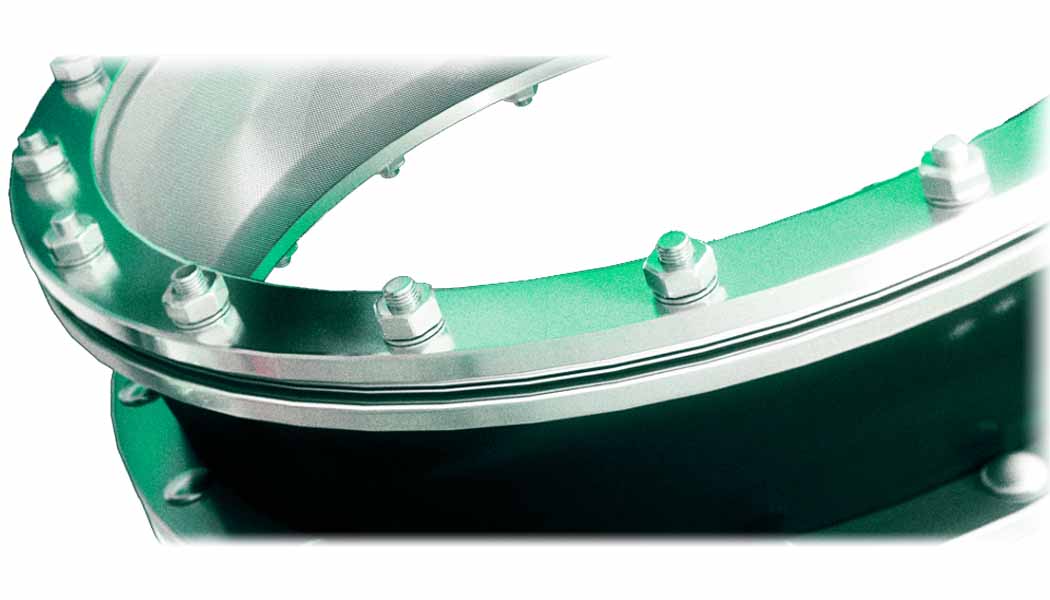
- Flanged mounting
- The strongest installation type.
- Resistant to high pressure and temperature.
- Recommended for aggressive environments and large diameters.
Compensation Capability
- Axial movement: 20–120 mm (depending on design).
- Lateral offset: 10–60 mm.
- Angular deformation: up to 15–30°.
- Torsion: depends on fabric type and layering, typically 5–10°.
Advantages of Fabric Expansion Joints
- High flexibility and versatility.
- Resistance to aggressive environments including SO₂/SO₃.
- Low weight and easy installation.
- No vibration or noise transmission.
- Long service life with proper layer selection.
Manufacturing and Ordering
Production is possible based on a drawing, sketch, photo, or on-site measurement. If required, we design the joint individually for the operating conditions.Submit a request for consultation or quotation